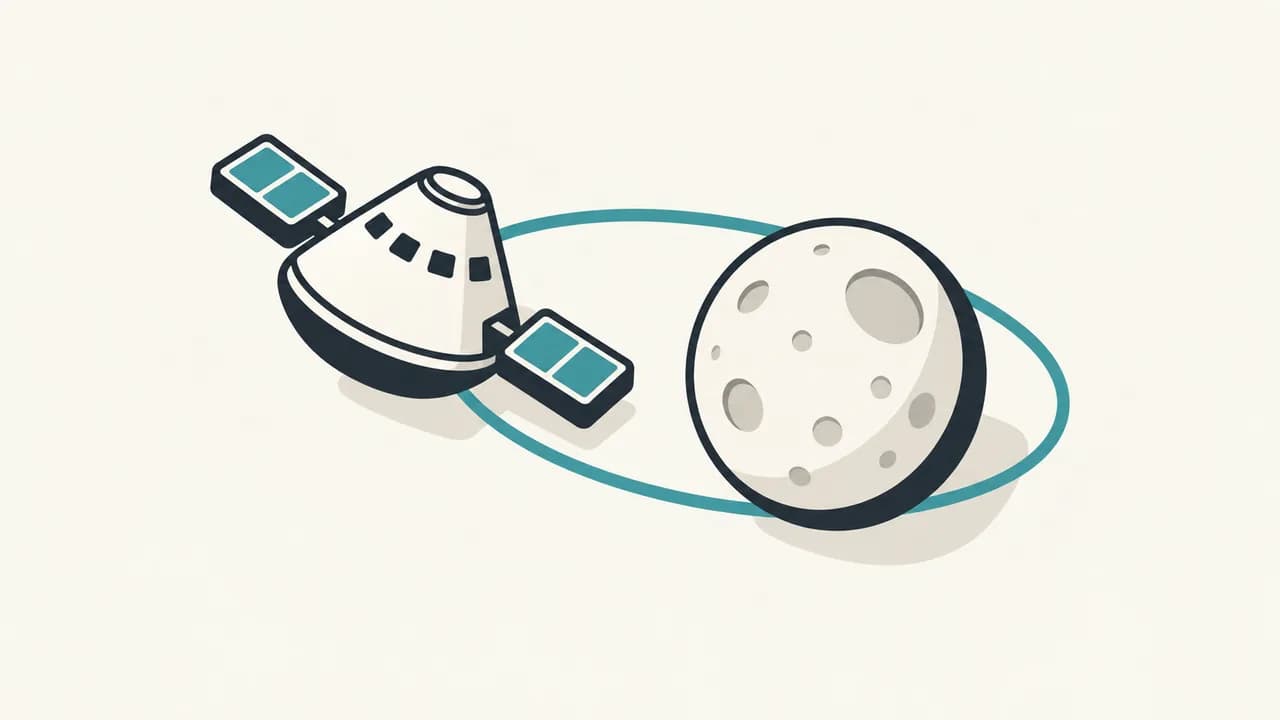
On April 3, 2026, at 12:35 AM CEST, NASA's Space Launch System (SLS) rocket lifted off from the Kennedy Space Center in Florida. Aboard the Orion capsule: four astronauts heading for the Moon. It is the first time since Apollo 17 in December 1972 — over 53 years ago — that humans are flying to the Moon.
The Crew
- Commander Reid Wiseman (NASA) — Mission Commander
- Pilot Victor Glover (NASA) — first Black astronaut on a lunar mission
- Mission Specialist Christina Koch (NASA) — holds the record for the longest spaceflight by a woman
- Mission Specialist Jeremy Hansen (CSA) — first Canadian on a lunar mission
The Mission
Artemis II is a 10-day test flight. The Orion capsule orbits the Moon without landing and returns to Earth. The objective is to verify all crewed systems in deep space: life support, navigation, communication, and the heat shield during reentry.
The most critical moment of the mission is the Translunar Injection Burn — the maneuver that sends the capsule from Earth orbit onto a lunar trajectory. This was successfully completed on the evening of April 3.
Why This Matters — Including for Tech
Artemis II is a test run for Artemis III, which aims to land humans on the Moon for the first time since 1972. The program targets a permanent lunar presence as a stepping stone for Mars missions.
For the tech industry, the program opens markets: SpaceX is building the lunar lander (Starship HLS), Intuitive Machines and Astrobotic are developing payload landers, and a growing ecosystem of startups is working on lunar habitats, resource extraction, and communications infrastructure.
The mission also demonstrates that government space programs function as risk underwriters for private investment. NASA takes on the most expensive and riskiest steps — thereby creating a market in which companies can invest.
Sources: NASA, ABC News Live Updates (04/03/2026), Live Science, TechStartups.