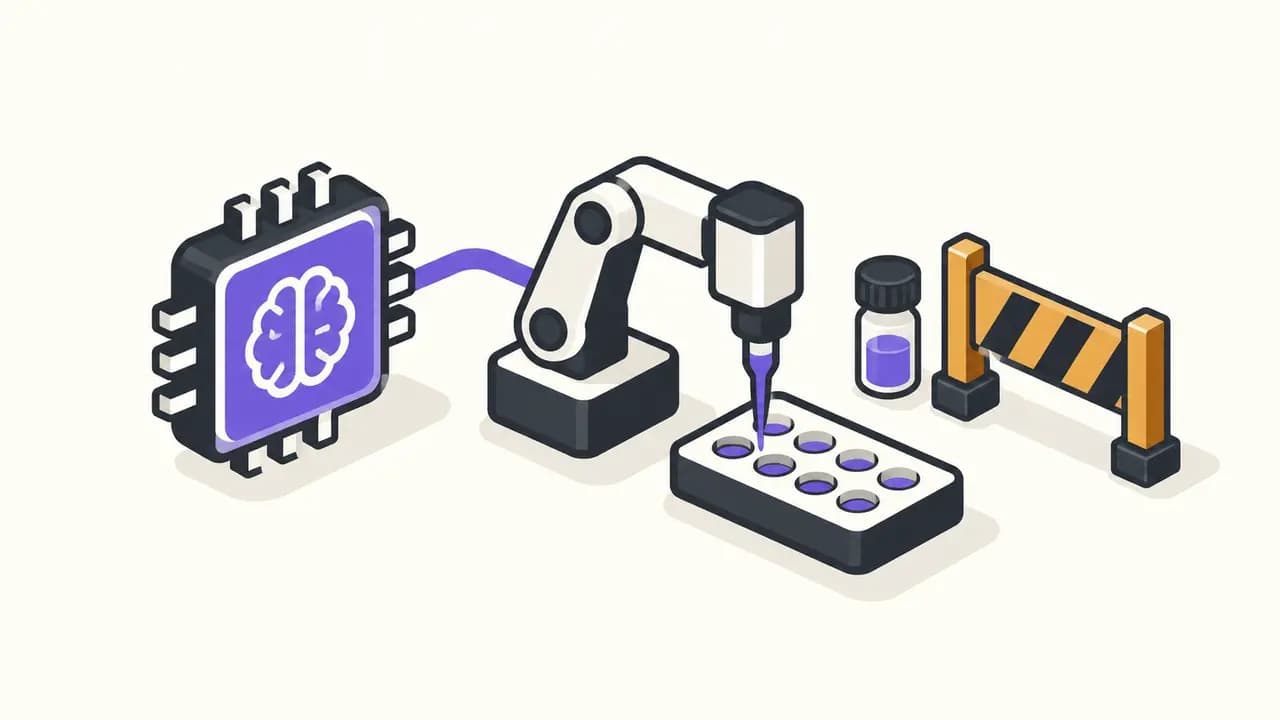
In brief: Anthropic operates a San Francisco Bay Area wet lab for physical biology experiments. The Claude stack now demonstrably extends from literature and data work into experimental execution. This does not prove autonomous drug discovery or produce a clinical candidate.
Confirmed, with deliberate limits
Anthropic's life-sciences head Eric Kauderer-Abrams confirmed the lab in a September 15 Reuters interview. The company conducts some work in-house and outsources other experiments. A spokesperson clarified that the facility is not specifically a drug-discovery lab. Its size, diseases and current experiments remain undisclosed.
Anthropic does not plan to run clinical trials, confining its role to early research, automation and preclinical work. A promising molecule would still need safety, efficacy and regulatory testing; a wet lab does not remove that chain.
From model to robot
The technical foundation is visible. Model Hardware Standard (MHS), previewed in August, provides common commands for microscopes, liquid handlers and robotic arms. In a Genentech test, Claude coordinated three instruments for a protein assay. It adjusted pipetting speeds from measurements, but initially mishandled bubbles and needed human guidance on the physics.
Anthropic opened its Life Sciences Verification Program on September 17. Vetted organisations get models with fewer biology restrictions; higher-risk projects require separate review. Anthropic monitors usage patterns instead of blocking each request and requires 30-day retention. It names account compromise, insiders and misdirected agents as core risks.
Pandorex Analysis
The chain now connects: Claude for Life Sciences links literature and research tools; MHS connects models to instruments; the access programme selectively relaxes safeguards; and Anthropic's lab returns physical evidence. The potential advantage is faster cycles between hypothesis, experiment and measurement.
That is also the limit of the news. Anthropic has shown neither a drug candidate nor autonomous end-to-end research. MHS trials show models detecting errors and optimising parameters, yet missing physical causes. Humans remain responsible for design, safety limits and interpretation.