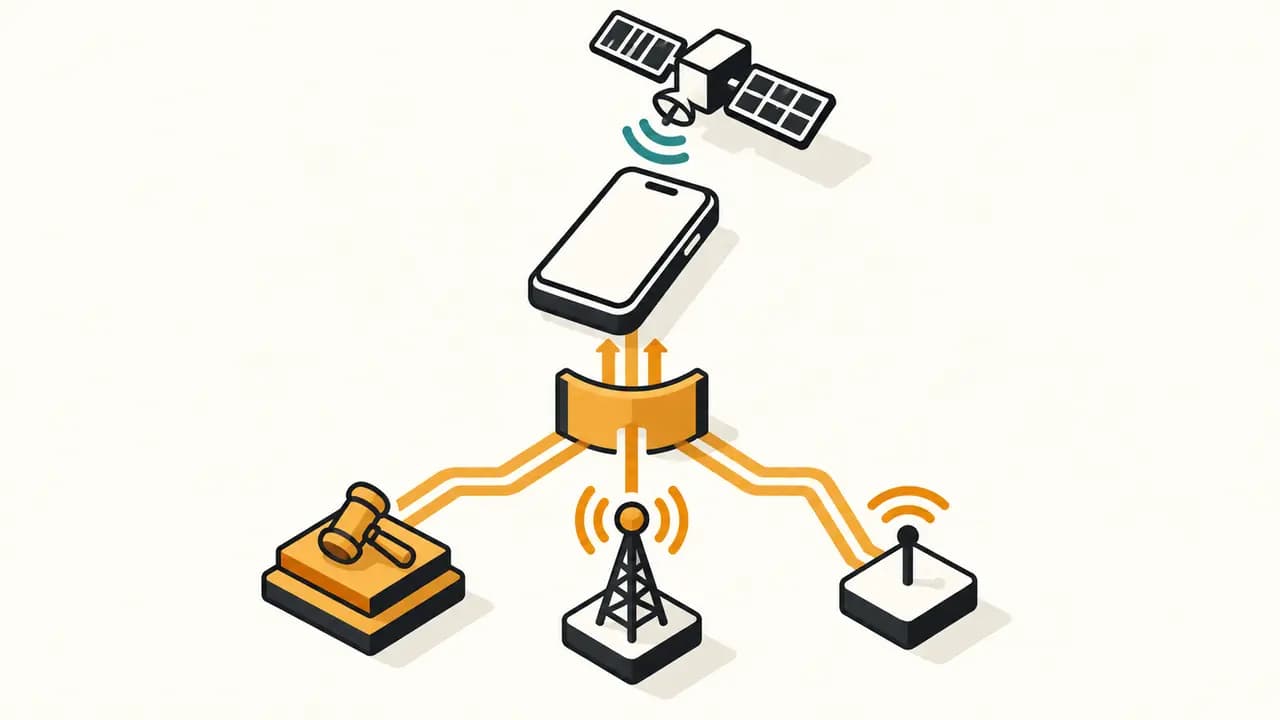
In brief: The FCC will vote on October 29 on preparing a 25 MHz direct-to-device auction and opening another 482 MHz for Supplemental Coverage from Space. Nothing has been awarded yet. Together with a separate unlicensed-band proceeding, this forms a three-track D2D framework.
A vote, not a completed spectrum release
According to Reuters, the FCC announced three steps: a proposed 25 MHz auction, another 482 MHz for satellite supplemental coverage, and modernised rules for flexible terrestrial, satellite and hybrid business arrangements. The meeting is scheduled for October 29, 2026. These are initial votes, not a completed auction or immediately effective spectrum release.
Direct-to-device links ordinary devices directly to satellites. Supplemental Coverage from Space (SCS) supplements terrestrial mobile networks through licensed frequencies and requires coordination with their rights holders. The cited 482 MHz are therefore not one contiguous, freely usable block. FCC texts following a vote must specify the bands, protection conditions and usage rights.
Economic pressure is visible: SpaceX acquired 65 MHz from EchoStar for $19.6 billion, according to Reuters. An April FCC document counted more than $28 billion in transactions across at least 130 MHz of D2D-relevant spectrum over 18 months. The auction would add a direct allocation route.
A third track uses unlicensed bands
Separately, the FCC is examining satellite links for Part 15 devices in the 2,400–2,483.5 MHz and 5,725–5,850 MHz bands. These total 208.5 MHz and already support unlicensed applications. The proceeding requires non-interference; comments are due November 9 and replies December 7, 2026.
Pandorex Analysis
The development points to three parallel access models: exclusively auctioned D2D spectrum, SCS over coordinated mobile licences, and experimental use of unlicensed bands. That could increase competition and coverage, but it also raises the coordination burden. The decisive factors will not be the added headline megahertz alone, but band location, transmit power, interference protection and priority relative to terrestrial networks. Until the FCC drafts are published, claims about range, data rates or specific devices are not sufficiently supported.