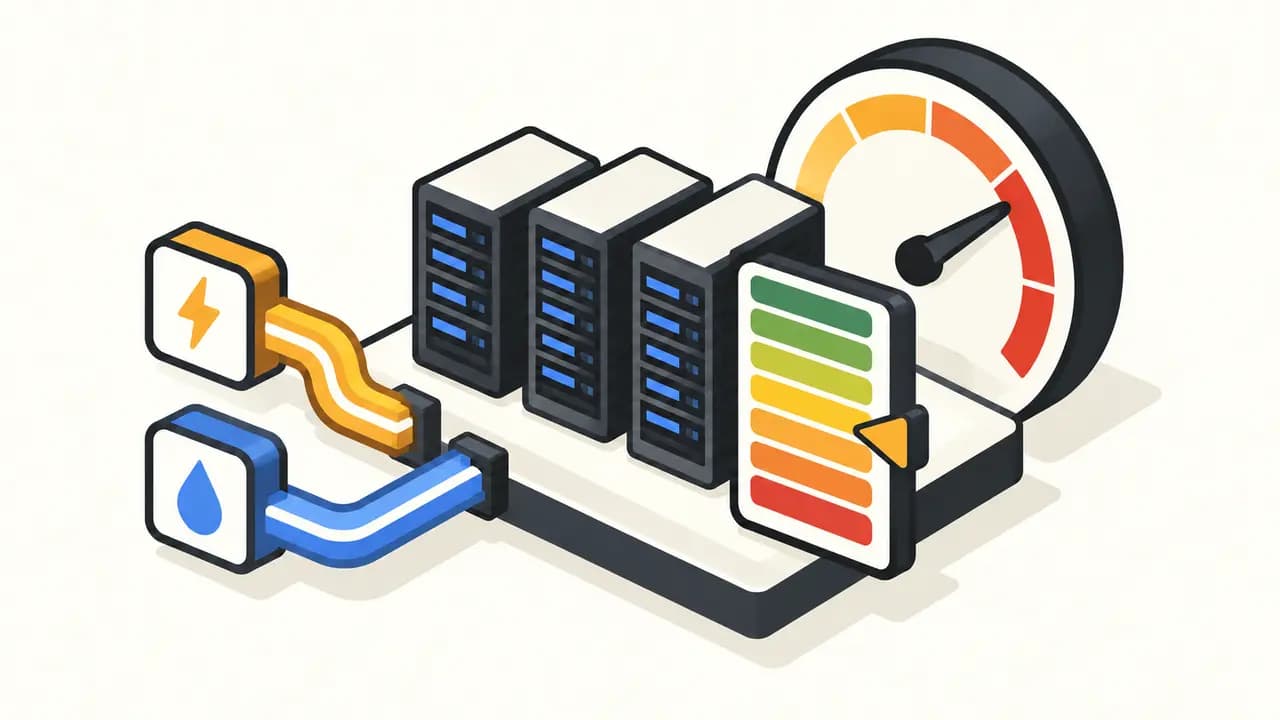
In brief: The European Commission has adopted a common sustainability label for data centres. It assigns separate A-to-G classes for energy and water efficiency, with the first electronic labels due by 15 August 2027. The crucial caveat is that good efficiency scores reveal nothing about a large facility's absolute consumption.
Two classes, no overall grade
The regulation uses Power Usage Effectiveness (PUE) for energy efficiency: class A covers values up to 1.15, while G starts above 1.9. Water Usage Effectiveness (WUE) has its own scale, with A up to 0.1 and G above 1.0. The label also shows location and size category, energy mix, cooling degree days, whether a facility provides grid flexibility and whether it is ready for waste-heat reuse.
The scheme covers facilities already subject to reporting with at least 500 kW of installed IT power demand. Smaller and not-yet-operational data centres may participate voluntarily. The EU database will generate labels annually from reported metrics, and operators must make them electronically available on request.
The delegated act is not yet in force. The European Parliament and Council have two months to object. If neither does, the regulation enters into force 20 days after publication in the EU Official Journal.
Pandorex Analysis: efficient can still be enormous
The label does not publish an individual facility's absolute electricity or water consumption, nor does it provide one overall grade. A hyperscale data centre can therefore achieve excellent PUE while still consuming more energy than a smaller, lower-rated facility. The regulation itself recognises further limits on comparison: an accompanying document must explain climate, size, age and occupancy, plus the trade-off between PUE and WUE. Aggregate totals are to be public only at member-state and EU level.
The scheme is therefore initially transparency and comparison infrastructure, not a consumption cap. The Commission puts EU data-centre electricity use at 68 TWh in 2024 and projects 114 TWh, or 3.2% of EU electricity demand, in 2030. A roughly two-year study on binding minimum standards has been running since January 2026. The label creates an evidence base for that work without prejudging the political decision on limits.