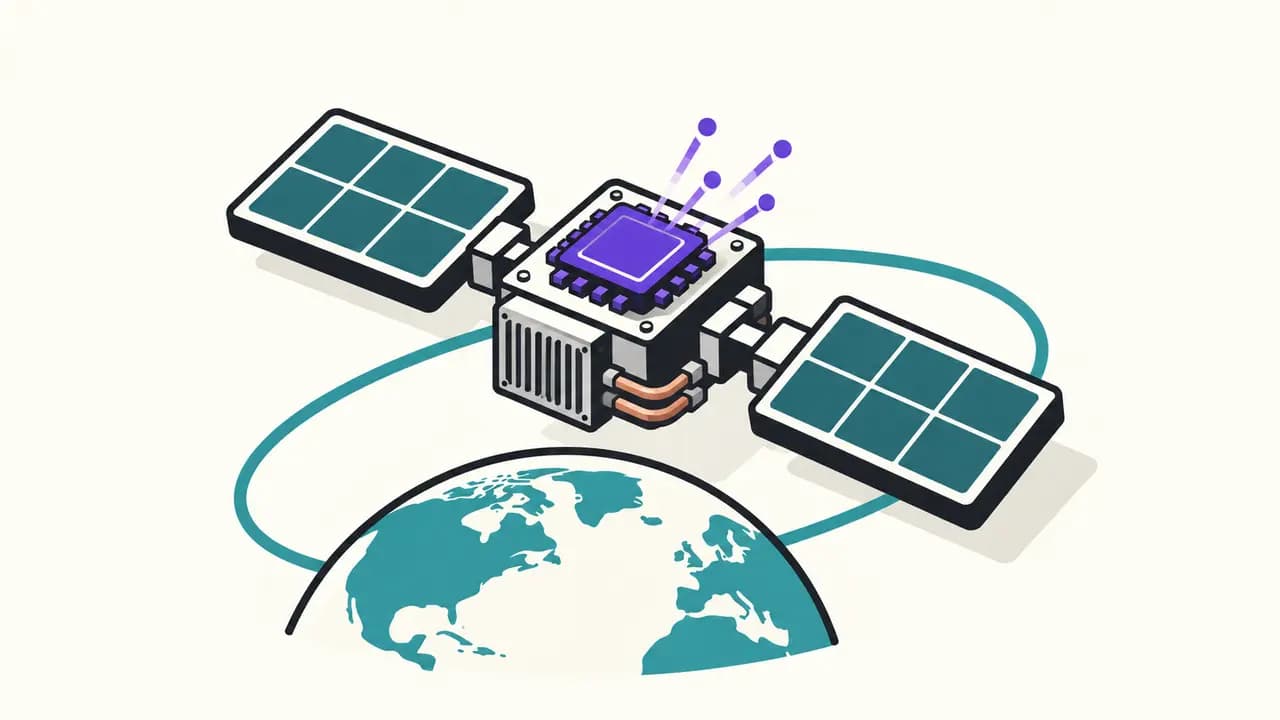
In brief: Google plans its first orbital Tensor Processing Unit (TPU) test next week. The Project Suncatcher satellite will examine launch stress, radiation and cooling. It is not a networked AI data centre: laser interconnect testing follows in 2027.
One satellite, Trillium TPUs and a narrow test scope
The Planet-developed prototype is due to fly on SpaceX's Transporter-18. During the ten-minute ascent, Google expects up to 10 g on the spacecraft and 50 to 100 g on components. The hardware survived three-axis vibration tests.
Trillium TPUs ran workloads under proton irradiation in a laboratory. Google says they survived more than a five-year mission's expected total dose. This proves neither error-free long-term operation nor conventional radiation hardening: particles can still cause bit flips, and Google gives no workload error rate.
Heat pipes and radiators remove waste heat. A thermal-vacuum chamber reproduced vacuum and temperature; only flight can test cooling, power and TPU together. Google gives no throughput, power draw or payload mass.
The network test comes later
Suncatcher proposes close-flying clusters with dozens of TPUs per satellite. Google's paper models 81 satellites within a one-kilometre radius, requiring optical links and precise formation control. This single satellite cannot test that architecture; two satellites are intended to trial laser links in 2027.
Pandorex Analysis: a real feasibility step, not infrastructure proof
The flight moves Suncatcher from laboratory measurements to real environmental data. It asks whether the platform survives launch and early operation. Cluster bandwidth, latency, formation flight, repairability, ground links and economics remain untested.
The up-to-eightfold solar claim applies to favourable sun-synchronous orbits, not a full energy or climate balance. Google's cost sketch assumes launch prices at or below $200 per kilogram by the mid-2030s—a learning-curve assumption, not a contract. Golem accurately describes the scope and missing laser link. It is a practical first step, not an orbital AI data centre.